
What’s the Best App to Learn Japanese in 2026?

Quick answer (tested in 2026): For speaking and pronunciation, start with Pimsleur or Speechling. For a structured all-round course, pick LingoDeer or Rocket Japanese. On a tight budget? Use Duolingo (free) plus WaniKani for kanji. Skip app-hopping — one primary app plus one booster is enough.
I've tested these apps in real study blocks of 7–14 days each — not sponsored demos. The goal was simple: find what moves the needle on speaking, grammar, kanji, and offline use for different learner types. Below you'll get a quick-picks table, a goal-by-goal breakdown, a Duolingo honest assessment, and a 10-question FAQ covering every common question I see from beginners.
- Best apps to learn Japanese in 2026: quick picks by goal
- Side-by-side comparison: the best Japanese learning apps tested
- Is Duolingo actually good for learning Japanese
- Best apps for Japanese conversation practice
- Best free apps to learn Japanese: what free actually covers
- Best Japanese learning apps for specific goals
- How to choose the right Japanese learning app: checklist
- Frequently asked questions: best app to learn Japanese
- Sources and resources
Best apps to learn Japanese in 2026: quick picks by goal
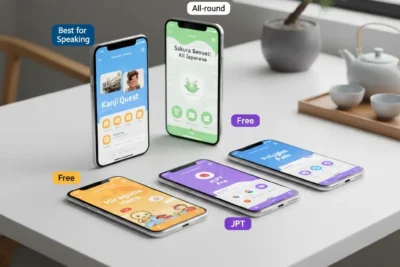
- Speaking and pronunciation — Pimsleur / Speechling
Natural dialogues, spaced listening, shadowing, and instant coach feedback. After 10 days of Pimsleur (25 min/day), my response lag dropped significantly; Speechling highlighted sounds I kept missing (like つ/tsu). - All-round structured course — LingoDeer / Rocket Japanese
Clear grammar notes, structured practice, built-in review cycles. LingoDeer's grammar explanations saved me from guessing particle use; Rocket's audio and culture sections made examples stick beyond the lesson. - Best free app to learn Japanese — Duolingo + WaniKani (free levels 1–3)
Best for building momentum before committing money. Duolingo keeps you consistent; WaniKani's radicals-first approach is the clearest kanji entry point available for free. - JLPT preparation — Bunpro + JPDB / WaniKani
SRS mapped to N5–N1 grammar and vocabulary. Short daily blocks (10–15 min) beat cramming sessions by week two in my testing. - Live conversation practice — italki / HelloTalk / Tandem
Turn passive knowledge into real spoken Japanese with 25-minute tutor sessions or language exchange partnerships.
Side-by-side comparison: the best Japanese learning apps tested
Prices are current list prices as of 2026; free tiers have real limits (see the Free section below for details).
| App | Best for | Key features | Free tier | Typical price | Our score |
|---|---|---|---|---|---|
| Pimsleur | Speaking / Pronunciation | Audio lessons, spaced recall, dialogues, car mode | Limited trial | ~$14.99–$19.99/mo | 9/10 |
| Speechling | Pronunciation feedback | Coach feedback, shadowing, sentence bank | Generous free | ~$19.99/mo | 8.5/10 |
| LingoDeer | All-round course | Grammar notes, drills, review system | Some units free | ~$11.99/mo | 9/10 |
| Rocket Japanese | Structured path | Audio + grammar + culture, lifetime option | Free trial | Course / lifetime | 8/10 |
| Duolingo | Free habit builder | Bite-size drills, gamified streaks | Yes (with ads) | Super optional | 6.5/10 |
| WaniKani | Kanji mastery | SRS radicals and kanji, mnemonics | Levels 1–3 free | ~$9/mo | 9.5/10 |
| Bunpro | JLPT grammar SRS | SRS grammar, N5–N1 example sentences | Trial available | ~$5–$7/mo | 8.5/10 |
| italki | Live conversation | 1-on-1 tutors, flexible session rates | No | Per lesson | 8/10 |
Is Duolingo actually good for learning Japanese
Duolingo is the most downloaded app for Japanese learning in the US — but it divides learners more than any other tool. Here is an honest assessment after testing it seriously for two weeks.
What Duolingo does well:
- Teaches hiragana and katakana effectively in the first few days
- Keeps you consistent through streaks and gamification — underrated for beginners who need a daily habit
- Zero cost for the core experience
- Works offline once lessons are downloaded
Where Duolingo falls short for Japanese:
- Grammar explanations are minimal or missing entirely — you're pattern-matching, not understanding
- Kanji coverage is shallow and inconsistent
- No speaking feedback — you tap or type but never actually speak
- Sentences become unusable quickly (not natural Japanese)
Verdict: Duolingo works as a warm-up or habit-keeper, but it should never be your only app. The best approach: use Duolingo for your daily streak while running LingoDeer (grammar) and WaniKani (kanji) in parallel. Think of it as the morning stretch before the real workout.
Best Duolingo alternatives for Japanese in 2026: LingoDeer (most similar structure, better grammar), Renshuu (free and more comprehensive), Busuu (community corrections), Bunpro (grammar focus).
Best apps for Japanese conversation practice
Speaking is where most learners stall. The three things that actually work: spaced listening, shadowing natural dialogues, and real feedback on your output.
- Pimsleur built automaticity — I stopped translating in my head and started responding directly.
- Speechling surfaced specific weak sounds through coach audio feedback; recording, comparing and retrying accelerated fixes faster than any other method.
- italki turned passive knowledge into real dialogue; 25-minute community tutor sessions lowered the scheduling barrier significantly.
- HelloTalk and Tandem connect you with native Japanese speakers for text and voice exchange — free for basic use.
For a full breakdown of conversation-focused tools, see our guide to the best Japanese chat and conversation apps.
10-minute shadowing routine that works
- Play a short dialogue at normal speed
- Whisper the rhythm along with the audio
- Speak with the audio at full volume
- Record yourself speaking the same dialogue alone
- Compare and fix one specific sound before repeating
Best free apps to learn Japanese: what free actually covers
Free Japanese learning is viable up to an intermediate level if you combine the right tools. The most effective zero-cost stack:
- Duolingo (free): daily habit and basic hiragana/katakana/kanji exposure
- WaniKani (free levels 1–3): radicals and kanji logic before you commit to a subscription
- Anki with community decks: SRS without a subscription — Core 2000 or Core 10000 decks are the standard
- NHK Easy News / Todai: graded reading with furigana for natural Japanese input
- Jisho.org: the most reliable free Japanese dictionary, works in any browser
Where free plans break down: no full grammar pathway, capped reviews, limited or no audio feedback. When you hit those limits, upgrade one bottleneck rather than paying for multiple apps simultaneously.
See our dedicated breakdown of the best free apps to learn Japanese for a full comparison of what each free tier covers.
Best Japanese learning apps for specific goals
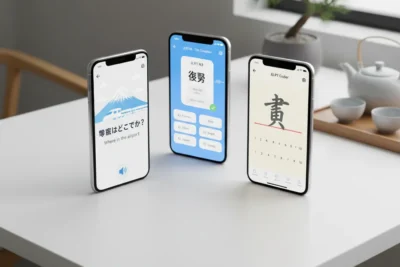
Best app to learn Japanese for beginners
Start with LingoDeer for structure or Duolingo if you need a zero-pressure entry. Add WaniKani (free levels) immediately — beginners who skip kanji training always hit a wall at intermediate level. Plan for 20 minutes per day minimum.
Best Japanese learning app for JLPT (N5 to N1)
Bunpro for grammar SRS mapped directly to JLPT levels. WaniKani for kanji (N5–N2 covered in full). JPDB for vocabulary frequency lists. Combine with official JLPT past-paper practice as the exam approaches. Mock tests matter more than extra SRS sessions in the final month.
Best app for learning kanji
WaniKani is the clearest system: radicals first, then kanji built from those radicals, then vocabulary using those kanji. Recognition before production. Anki with a proven deck is the free alternative. Avoid apps that teach kanji in isolation without context sentences — retention is low.
Full comparison in our kanji learning app guide.
Best app for Japan travel
Google Translate (camera mode for menus and signs), Yomiwa (offline kanji recognition), and a downloaded offline dictionary for areas without signal. Download all offline content before you leave. See our Japan travel app guide for the full must-have list.
How to choose the right Japanese learning app: checklist
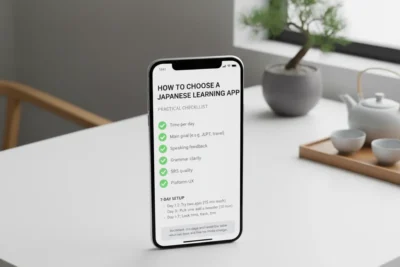
Before choosing, answer these:
- How much time per day? (15 min = one app; 45 min = primary + booster)
- Primary goal: speaking, reading, JLPT, or travel phrases?
- Budget: completely free, or willing to pay for one tool?
- Do you need offline access?
- Beginner (hiragana not solid yet) or intermediate (kana done, working on kanji)?
7-day setup that works:
- Days 1–2: Trial two apps aligned to your goal (15 min each)
- Day 3: Pick one primary; add a kanji or listening booster (10 min)
- Days 4–7: Lock a time slot; track weekly not daily; drop anything you're skipping
Need a quick lookup tool while studying? A solid Japanese dictionary app complements any learning system.
Frequently asked questions: best app to learn Japanese
What is the best app to learn Japanese for beginners
LingoDeer for structure with clear grammar explanations, or Duolingo if you want a no-pressure start. Add WaniKani free levels from day one — the radicals-first system is the fastest path to reading kanji consistently.
Is Duolingo enough to learn Japanese
No. Duolingo builds a habit and covers hiragana and katakana well, but it does not teach grammar clearly, does not cover kanji in depth, and provides no speaking feedback. Use it as a daily habit-keeper alongside LingoDeer (grammar) and WaniKani (kanji).
What is the best free app to learn Japanese
The best free stack: Duolingo (habit), WaniKani levels 1–3 (kanji), Anki with Core 2000 deck (vocabulary SRS), and NHK Easy News (graded reading). No single free app covers everything — combining these four costs nothing and gets you to solid beginner level.
How long does it take to learn Japanese with an app
For conversational basics (N4 level): 12–18 months at 30–45 minutes per day with a structured app. For N2 (advanced professional): 3–5 years. Apps accelerate the process but cannot replace regular conversation practice with real speakers.
What is the best Japanese learning app for speaking practice
Pimsleur for audio-driven speaking automaticity. Speechling for pronunciation feedback from real coaches. italki for scheduled 1-on-1 sessions with native Japanese tutors. Use all three at different budget points.
LingoDeer vs Duolingo for Japanese: which is better
LingoDeer is significantly better for actually learning Japanese. It explains grammar rules, progresses logically, and uses natural Japanese. Duolingo is better for maintaining a daily streak. If you can only choose one for real learning, choose LingoDeer.
What is the best paid app to learn Japanese
WaniKani (~$9/month) for kanji — the return on investment is the highest of any paid tool. Bunpro (~$5–7/month) for grammar SRS. Pimsleur (~$14–19/month) if speaking is your priority. You do not need all three — pick based on your biggest weakness.
Can I learn Japanese for free with an app
Yes, to a solid beginner level. Duolingo (free), WaniKani (levels 1–3 free), Anki (free), and NHK Easy (free) together cover habit, kanji, vocabulary SRS, and reading input. Grammar explanations are the main gap in free tools — Tae Kim's Grammar Guide (free online) fills that gap.
What apps do Japanese learners recommend on Reddit
The most consistently recommended stack on r/LearnJapanese: Anki for SRS, WaniKani for kanji, Bunpro for grammar, and italki or HelloTalk for speaking. Duolingo is generally discouraged as a primary tool but accepted as a streak-maintenance app.
Which Japanese learning app is best for iPhone vs Android
All major apps (Pimsleur, LingoDeer, Duolingo, WaniKani, Bunpro, italki) are available on both platforms. Choose your app by goal first, then download. The main difference is that WaniKani is web-primary — the iOS app is unofficial but excellent (Tsurukame). On Android, AlliCrab is the equivalent.
Start with the pick that fits your goal. Pimsleur or Speechling for speaking. LingoDeer or Rocket for structure. Duolingo plus WaniKani for free. One primary app, one booster, 20 minutes a day — that beats any perfect plan you don't follow.
Sources and resources
- JLPT official level summary: jlpt.jp
- NHK Easy Japanese (graded reading): nhk.or.jp/news/easy
- Tae Kim's Guide to Learning Japanese (free grammar reference): guidetojapanese.org