
How to Move to Japan: The Step-by-Step Guide You Actually Need

If “I want to live in Japan” has been sitting on your notes app for years, this is the page that finally makes it real. The process isn’t magic—it’s matching your profile to the right visa, saving a sensible budget, and following a checklist the moment you arrive.
Here’s the honest version: most delays come from missing documents, underestimating deposits, and not knowing what to do in the first 14 days. We’ll fix that. Start by picking the visa path that fits (work, highly skilled, student, spouse, startup). Next, map your costs—not just flights and visa fees, but shipping, key money, and a 60–90-day buffer while you set up life admin.
When you touch down, you’ll know exactly what to do: register your address, get MyNumber and NHI, then set up bank + phone/Internet. We’ll also show housing strategies that work for newcomers and where people actually find jobs (and what JLPT level helps).
You can drill into details whenever you need—costs, banking and SIM, study routes, working holiday, or the best places to live in Tokyo—through the links as you read. No fluff, no vague advice. Just a clear plan to move to Japan in 2025 without burning time or money.
- Quick answer: can you really move to Japan in 2025? (What it takes)
- Visa routes explained (choose your path)
- Costs & budget to move to Japan (realistic ranges)
- The first 14 days after arrival (checklist)
- Housing basics for newcomers (how to rent without history)
- Jobs & language: finding work and JLPT tips
- FAQs people really ask
Quick answer: can you really move to Japan in 2025? (What it takes)
Eligibility snapshot. Most newcomers qualify through one of five routes: Work / Highly Skilled, Student (often leading to work), Spouse/Family, Startup/Business, or Working Holiday (for certain nationalities/ages). Each path has its own documentary requirements and timeframes. If you can’t match any category today, the practical approach is to qualify into one (e.g., gain a job offer, enroll in a language/vocational program, or build a spouse-eligible case if applicable).
Timelines you should expect. From decision to arrival, typical journeys take 2–6 months, mainly driven by job searches or school admissions, the COE stage (if needed), consulate appointment availability, and document translations. Your fastest turnaround tends to be student or Working Holiday; your longest is business/startup.
The core playbook.
-
Pick your visa path and list the exact documents.
-
Book milestones on a calendar (e.g., “submit COE,” “consulate slot,” “housing search”).
-
Save for 60–90 days of living + deposits (see next section).
-
Upon landing, register your address in 14 days, get MyNumber and NHI, then secure bank + phone.
-
Keep originals + copies of key documents with you at all times.
Use the Live in Japan hub to navigate visa routes, costs, housing, and first-week admin in one place as you build your plan.
Visa routes explained (choose your path)

Work & Highly Skilled (who qualifies)
This is the most common long-term path. You’ll typically need a job offer from a Japanese employer that matches one of the recognized work statuses (official visa categories) such as Engineer/Specialist in Humanities/International Services. Highly Skilled Professional (HSP/J-SIP) recognizes advanced education, income, or research credentials and can accelerate permanent residence timelines. Strong resumes and roles in engineering, IT, finance, translation, and global operations see consistent demand.
What to prep: degree/diplomas, resume in JP/EN, portfolio or GitHub where relevant, references, and any required translations. Expect to coordinate with HR for COE if your case requires it. Use your JLPT as a plus, but it’s not always mandatory for tech/English-speaking environments.
Student → work path
Language schools and universities are a proven way to enter Japan and later switch to work. You’ll need proof of admission, funds, and housing plan. While studying, build a work-ready profile (part-time work rules apply) and network with companies that sponsor graduates. Many employers hire from language/vocational pipelines for customer-facing or bilingual roles.
Spouse/Family & Working Holiday
Spouse/Dependent routes are straightforward when documentation is complete (marriage registration, proof of relationship, finances). Working Holiday (age-limited, nationality-dependent) is powerful for a year-long stay to explore jobs, study, and test neighborhoods before switching to longer routes.
Startup & Business options
For founders or managers, Business/Management or local startup programs can facilitate entry, but you must document capital, business plans, and office arrangements. Expect heavier compliance, longer timelines, and higher costs. If you’re early-stage, consider arriving as student/working holiday, validate product-market fit, then upgrade your status.
Costs & budget to move to Japan (realistic ranges)
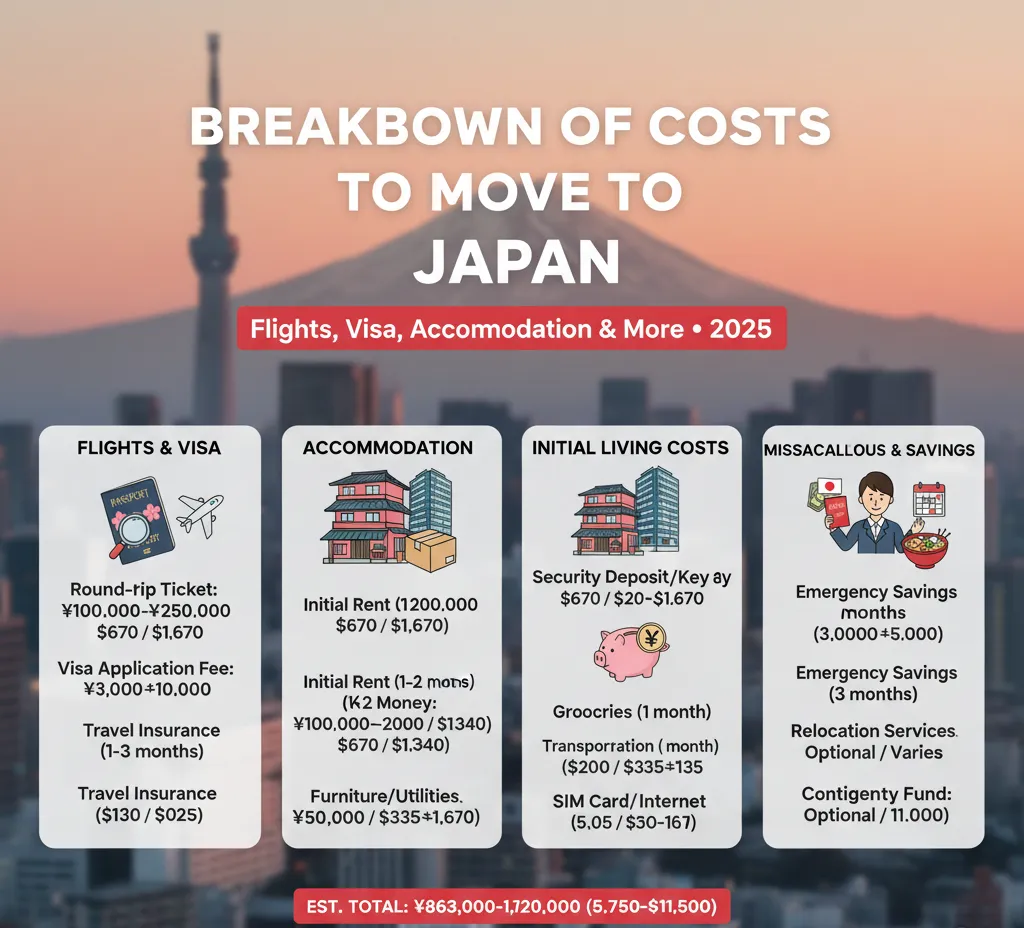
Visa & paperwork, translations, flights
Budget for application fees, translations/certifications, and flights. Build a small buffer for repeated appointments or couriering original documents. If a COE is involved, factor extra weeks for issuance and any agency/legal support you might use.
Shipping & first-month housing deposits (key money, guarantor)
Shipping varies widely: from luggage-only to sea freight. In housing, newcomers often face multiple deposits: shikikin (security), reikin (key money, sometimes non-refundable), agency fee, and the guarantor service if you don’t have a local guarantor. This first month can be the largest one-time outlay.
90-day runway (cash buffer)
Plan 60–90 days of living costs while you complete admin and start income. Include NHI enrollment, SIM/Internet, transport, and initial furnishing. If you’re arriving without a job, add extra runway and consider short-term housing (monthly apartments) to reduce upfront deposits.
For itemized ranges covering fees, translations, flights, shipping, deposits, and a 60–90-day buffer, see this cost of moving to Japan breakdown.
The first 14 days after arrival (checklist)
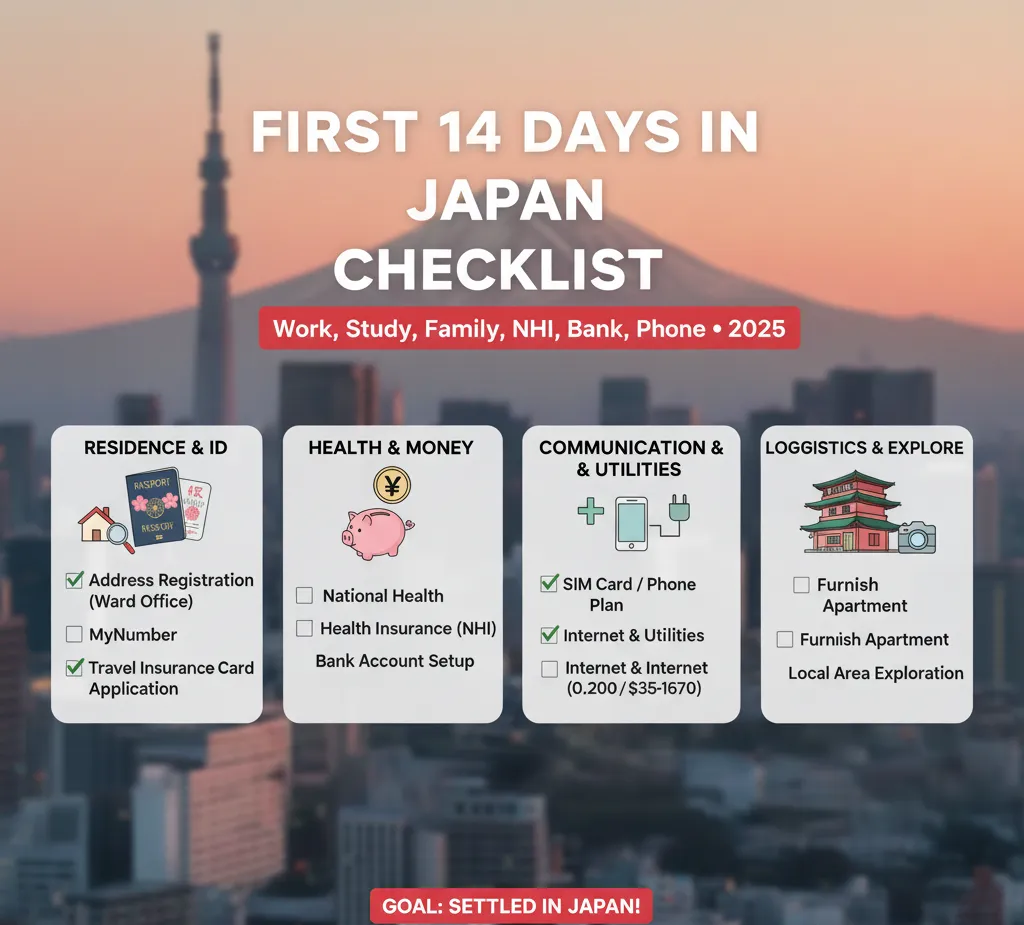
Residence card & address registration (14 days)
Carry your residence card at all times. As soon as you fix your address, register it at the ward/city office within 14 days (ward office guide). This enables MyNumber issuance/activation and ties into health insurance and tax records. Keep copies of your lease/contract and your passport.
MyNumber & National Health Insurance (NHI)
MyNumber (about MyNumber) is your personal ID for taxes and social services. After address registration, you’ll enroll in NHI (unless your employer covers you under shakai hoken). Bring your residence card and evidence of address. Ask for the NHI card issuance timeline and any premium estimates so you can budget.
Bank account + SIM/Internet basics
Once you have an address and basic ID, open a bank account and secure a SIM (or eSIM) with a plan that matches your data needs. Internet installations can take time—arrange a pocket Wi-Fi or a temporary solution if you work remotely.
Once your address is registered and NHI is set, follow this bank, phone and internet setup guide to get payments and connectivity running smoothly.
Housing basics for newcomers (how to rent without history)
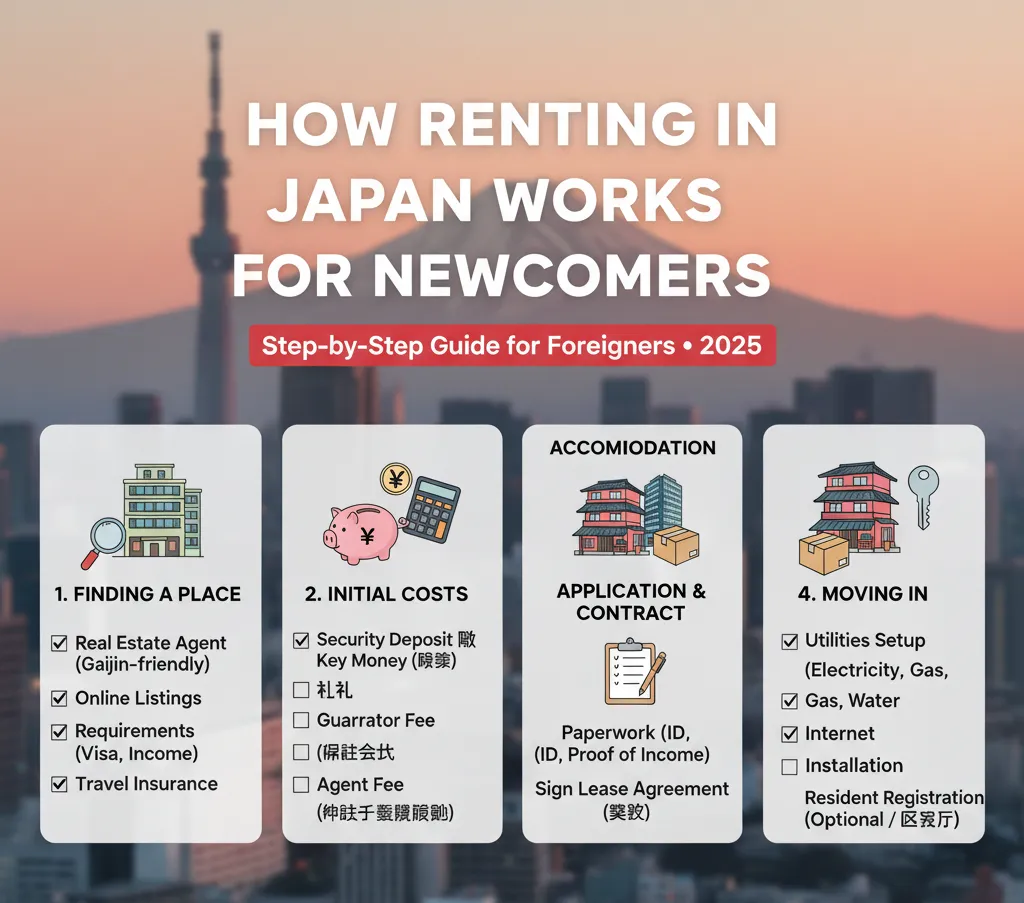
Guarantor, deposits, agency flow
Most leases expect a guarantor or a guarantor company (paid service). You’ll also see key money and agency fees. Ask up front for a line-item quote: deposit(s), key money, agency fee, guarantor fee, lock-change fee, and first month’s rent. Properties that market to newcomers often bundle services and accept foreign documentation more flexibly.
Short-term options to get started
If your runway is tight or your documents are still in transit, start with monthly apartments or sharehouses aimed at newcomers. This reduces upfront deposits and buys time to explore neighborhoods and assemble paperwork for a longer lease.
If Tokyo is on your shortlist, compare neighborhoods with this overview of the best places to live in Tokyo for new arrivals.
Jobs & language: finding work and JLPT tips
Where people actually get jobs
Practical channels: company career pages, global job boards, and Japan-specific boards such as find jobs in Japan, find jobs in Japan and find jobs in Japan. Target roles with clear sponsorship history or English-forward teams (tech, globalization, customer ops). Tailor your resume to Japan-friendly formats, highlight practical achievements, and prep for case-style interviews.
JLPT levels that matter
JLPT doesn’t measure speaking fluency perfectly, but it’s a useful proxy for HR filters. N2 opens many doors in customer-facing roles; N1 helps with compliance-heavy or writing-intensive work. Tech and multinational teams may hire without JLPT if your hard skills are tight and the team language is English.
FAQs people really ask
How much does it cost to move to Japan?
Plan for visa/paperwork + flights + housing deposits + 60–90 days runway. Exact figures depend on city and shipping choices. See /live-in-japan/cost-of-moving-to-japan.
How to move to Japan from the US?
Same playbook, but US applicants often have predictable timelines via Japanese consulates; prepare US-issued documents and translations early. Consider a student or work entry depending on your profile. See the visa routes above.
How to move to Japan permanently?
There’s no instant “permanent move.” Most people enter on a long-term status (work, spouse, HSP) and later apply for longer residence or PR after meeting time/income criteria.
How hard is it to move to Japan?
It’s process-heavy, not impossible. The two friction points are matching a visa category and front-loading the budget for deposits and setup. With a calendar plan and checklists, you de-risk both.
Moving to Japan becomes simple when you turn it into a calendar plan. Pick your visa path, list the exact documents, and give yourself a 60–90-day runway. Book appointments now—COE steps, translations, and consulate slots—and track each milestone. Once you land, follow the first-14-days checklist: register your address, get MyNumber and NHI, then open your bank account and set up phone/Internet. If deposits feel heavy, start in short-term housing while you scout neighborhoods. Use the links in this guide whenever you need detail: costs, banking/SIM, study options, Working Holiday, and the best places to live in Tokyo. You don’t need to know everything today—just the very next step. Save this page, grab the checklist, and block your first three tasks on your calendar. That’s how you move to Japan without burning time or money.